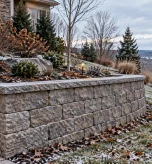
Retaining wall winter preparation is the fall work that protects your wall from water, ice, and frost heave before the ground freezes. If your wall has a bulge, a wobbly capstone, or a crack that gets wider every spring, you’re not alone. Bucks County homeowners deal with this every year, and it’s frustrating to watch a wall you paid good money for start to lean. Most people patch the cracks or glue the caps back down, but the damage keeps coming back because the real problem is hidden behind the wall. In this guide, we explain why Pennsylvania winters are so hard on retaining walls, how to spot trouble early, and what to do before the first hard freeze. Paz Landscaping has built and repaired walls in Bristol, Langhorne, and the surrounding area since 2013.
What You’ll Learn
- What Is Freeze-Thaw Damage?
- The Real Causes Behind Winter Wall Damage
- How to Spot Winter Risk in Your Wall
- Retaining Wall Winter Preparation: Your Solution Options
- Why Homeowners Choose Paz Landscaping
- Frequently Asked Questions
- Next Steps
What Is Freeze-Thaw Damage and Why Does It Hurt Retaining Walls?
Freeze-thaw damage happens when water soaks into the soil behind your wall, freezes, expands, and then thaws again. Water grows about 9% in volume when it turns to ice. In southeastern Pennsylvania, temperatures cross 32°F dozens of times each winter, and every cycle pushes on your wall. One push won’t knock it over. Several winters of pushing will.
Common warning signs include:
- The wall leans forward or bulges in the middle
- Blocks are cracked or shifted, especially near the top
- Capstones are loose, tilted, or missing
- Soil washes out from the base or through the joints
- Gaps open up between the wall and nearby steps or patios
A failing wall doesn’t fix itself. A small lean in March can become a collapse by the next spring, taking plants, fencing, or part of a patio with it.
The Real Causes Behind Winter Retaining Wall Damage
In our 10+ years working on walls around Bucks County, we’ve found that winter damage almost always traces back to one of four causes.
1. Water Trapped Behind the Wall
Poor drainage is the number one cause we find. Proper retaining wall installation includes at least 12 inches of clean crushed stone behind the blocks and a perforated drain pipe at the base. Many older walls, and plenty of DIY walls, were backfilled with clay dug out of the yard. That soil holds water like a sponge, and when it freezes, it presses hard against the back of the wall.
2. Heavy Clay Soil
Bucks County’s heavy clay soil makes every drainage problem worse. Clay drains slowly, so water sits behind a wall for days after a storm. In older neighborhoods around Levittown, Fairless Hills, and Croydon, and on low lots near Neshaminy Creek, we often find walls set right on native clay with no stone base at all.
3. A Weak or Shallow Base
The base should be compacted gravel, set level, with the first row of block buried below grade. If the base was thin or skipped, frost can lift one section while the rest stays put. That uneven heave causes the stair-step cracks you see running through block joints.
4. Clogged Outlets and Misdirected Water
Fall leaves and mulch clog weep holes and drain outlets. A downspout that empties above a wall can dump hundreds of gallons into the backfill in one storm. Rock salt from nearby walkways also eats away at concrete block and caps. DIY fixes often fail because they treat what you can see, not where the water goes.
How to Spot Winter Risk in Your Retaining Wall
Take 15 minutes this fall and walk your wall with this checklist:
- Sight down the wall. Look along the top from one end. Any bow or dip is a warning.
- Check for lean. Hold a level against the face. A wall tipping toward you is losing the fight with the soil behind it.
- Walk the top after rain. Soggy ground behind the wall means drainage is failing.
- Look at the base. Watch for washed-out soil, bulging bottom blocks, or new gaps.
- Find the drain outlets. If you can’t find where water exits, it has nowhere to go.
When to call a pro: Any wall over 3 feet tall that shows lean, bulging, or fresh cracks should be checked by a retaining wall contractor before winter. Loose caps and clogged outlets on a short garden wall are usually safe to handle yourself.
Retaining Wall Winter Preparation: Your Solution Options
DIY Steps Before the First Freeze
- Clear leaves and debris from weep holes and drain outlets
- Extend downspouts so water drains 5 to 10 feet away from the wall
- Reset loose capstones with masonry adhesive on a dry day above 40°F
- Use sand or calcium magnesium acetate instead of rock salt near the wall
- Don’t pile shoveled snow on top of or behind the wall
What not to do: Don’t pack mortar or caulk into the gaps between blocks. Segmental block walls are built to let water pass through the joints. Sealing them traps more water inside and makes freeze-thaw damage worse.
Professional Retaining Wall Repair
If the wall is leaning, bulging, or losing soil, it needs a rebuild. We take down the damaged section, remove the wet clay backfill, and:
- Rebuild the base with compacted gravel
- Install a perforated drain pipe at the footing with a clear outlet
- Backfill with clean crushed stone wrapped in filter fabric
- Add geogrid reinforcement on taller walls
- Reset and secure the capstones
Most section repairs take 1 to 4 days, and fall is the best time since the soil is still workable. A properly rebuilt section should last for decades, while patching a failing wall every spring costs more over time. Walls over 4 feet tall usually need a building permit too, and an experienced retaining wall builder handles that for you.
Why Bucks County Homeowners Choose Paz Landscaping
We’ve built and repaired retaining walls across Lower Bucks County since 2013. We know how clay behaves in Bensalem, how older yards drain in Levittown, and how sloped lots in Yardley and Newtown handle runoff. That local knowledge shapes every retaining wall design we put on paper. When you work with our hardscape company, you get:
- Over 10 years of local hardscaping experience
- Licensed Pennsylvania contractor (PA118491), fully insured
- BuildZoom score of 96, top 20% of Pennsylvania contractors
- Family ownership, with Angel Paz personally involved in projects
- Honest advice. If your wall only needs a small fix, we’ll tell you.
Frequently Asked Questions About Retaining Wall Winter Preparation
When should I prepare my retaining wall for winter in Bucks County?
The best window is late September through mid-November, before the ground freezes. That leaves time to clear drainage, reset loose caps, and schedule repairs while the soil is workable. Once the ground freezes solid, most rebuilding has to wait until spring.
How much does a retaining wall contractor charge for repairs in Bucks County?
Small fixes like resetting capstones or clearing drain outlets are usually a modest cost. Rebuilding a failed section costs more because it involves digging, new drainage, and new base material. Price depends on wall height, length, access, and materials. Paz Landscaping gives free on-site estimates so you know the real number up front.
Can I fix a leaning retaining wall myself?
Usually not. A lean means the soil behind the wall is pushing harder than the wall can hold, usually from trapped water or a failed base. The section needs to be rebuilt with proper drainage. Short garden walls under 2 feet are sometimes a manageable DIY project.
Is a leaning retaining wall dangerous?
It can be. Walls holding back more than 3 feet of soil can fail with little warning, especially during a spring thaw when the ground is soaked. Keep kids, pets, and heavy loads like vehicles away from a leaning wall, and have a hardscape contractor look at it soon.
What causes retaining walls to fail in Pennsylvania?
Most failures come from poor drainage, a weak base, and freeze-thaw cycles working together. Clay soil holds water behind the wall, and when that water freezes, it pushes the wall outward. Walls built without crushed stone backfill and a drain pipe are the most likely to fail.
Do you repair retaining walls in Langhorne and Levittown?
Yes. Paz Landscaping builds and repairs retaining walls throughout Bucks County, including Langhorne, Levittown, Bristol, Bensalem, Fairless Hills, Morrisville, Penndel, Yardley, and Newtown. We’re based in Bristol and have served the area since 2013.
Next Steps: Protect Your Wall Before the First Freeze
- Water behind the wall, not the cracks in front, causes most winter damage
- Clear drain outlets, redirect downspouts, and reset loose caps this fall
- Leaning or bulging walls need a real rebuild, not a patch
- Fall is the best time to schedule retaining wall repair in Bucks County
Good retaining wall winter preparation now saves you a bigger bill in spring. Call Paz Landscaping at (267) 274-8515 or visit us to book a free, no-obligation wall inspection. We’ll walk the wall with you and give you a clear price. Hours are Monday to Friday, 7 AM to 5:30 PM, and Saturday, 7 AM to 12 PM. We serve Bristol, Langhorne, Levittown, Bensalem, and all of Bucks County.
About the Author
Angel Paz is the founder and owner of Paz Landscaping & Services Inc, a family-owned hardscaping and landscaping company based in Bristol, PA. Since 2013, Angel and his crew have built patios, walkways, retaining walls, and drainage systems for homeowners and businesses across Bucks County. His hands-on background in hardscape construction means every project is planned around local clay soil and hard winters. Paz Landscaping is a licensed Pennsylvania contractor (PA118491).